
Subjects in Context
Listen, we’ve all (those of us that study(ied) mechanical engineering) Googled “What do mechanical engineers do?” and gotten an answer that infers quite a lot of common knowledge. I found the answer to be confusing and not helpful. So, I’m endeavouring to answer the question that we actually mean to ask:
“What are the subjects that Mechanical Engineers study, and how do they build up to a useful degree that is so diverse?”
I could introduce you to all the subjects that a mechanical engineering student would encounter, but all that would do is clutter your mind. I could walk you through the physical categorisation of the details of the subjects, sort of like a topic study, but that would get boring and unnecessarily detailed (look out for the series coming soon!). I won’t do those things now, I will categorise and structure the subjects as broadly, and specifically as possible to answer your curiousity and lead you toward a “yes” or “no” of whether you’d like to endeavour the field.
It’ll go fast. It’s an answer, not a feeling.
Answer
The broad categories are:
Supplementary fundamentals - the subjects in this category support those in the world that do technical work.
Fundamentals - the subjects in this category support those in the world that do engineering.
Core subjects - the people that study these subjects may become specifically mechanical engineers.
Specialisation subjects - the people that study these subjects become geniuses in their specific mechanical engineering sector.

In the supplementary category, we’ll place Graphic Communication, Statistics, Programming and Process and Project Management. You can imagine how these support any kind of technical work. These are transferable skills.
In the Fundamentals category, we’ll place Physics, Chemistry, Mathematics and Material Science. I guess the level to which each subject is studied would differ according to the specialisation of the engineer. Mathematics, generally, for most engineers, would include Calculus, Linear Algebra, Differential Equations and Numerical Methods. Mkay, more detail would be too much detail.
Moving along swiftly, the Core Subjects include Mechanics and Thermodynamics. The simplicity of this completely broke my mind for so many years. I didn’t get it. You will: we’ll get into it soon.
Finally, Specialisation. I mean, fill in the blank, but a few include: Vehicle Dynamics, Aeronautics, Power engineering (Renewable, Fossil Fuels), Heat and Mass Transfer, Maintenance Engineering, Optimum Design. You can definitely think of so many more and extend the list to your pleasure.
I want to get to the good stuff.
The Good Stuff
Alrighty, Mechanics.
Mechanics is the study of things move when subjected to a force.
When subjected to a force, a thing (not yet defined) could either not move (in which case the subject-matter in Statics applies), or it could move (in which case we apply Dynamics subject matter). Should the thing (not yet defined) move, and Dynamics be applied, Vibrations may be present.
Now, we define the thing. It could be a solid or a fluid. Note, that a fluid contains the definition for some substance that has no fixed shape and yields easily to external pressure, therefore includes gases and liquids. Should the thing be a solid, we apply the principles studied in Solid Mechanics, here, Material Science also plays a role. Should the thing be a fluid, we apply the principles of Fluid Mechanics.
If we were to complicate the “things” we might get to all sorts of parts. Here, we can include the principles of Design and Manufacturing. If we were to complicate the arrangement of “things”, we might get to Structures, in which case we apply Structural Mechanics principles.
Now, Thermodynamics.
Thermodynamics is the study of the relations between temperature, energy, heat and work. The introduction of cycles: refrigeration, heating, power cycles and others… From this, we find the definitions and analysis of making things do work for us.
When we want to design in this space, we apply Machine Design principles.
The intricacy of machines, and systems of machines and all the different entities that need to be monitored and controlled, now makes it possible to use the principles defined in Control Systems.
It’s very intricate. It’s very simple. It builds in complexity. It’s generic. It’s broad. It’s clear. Here it is:
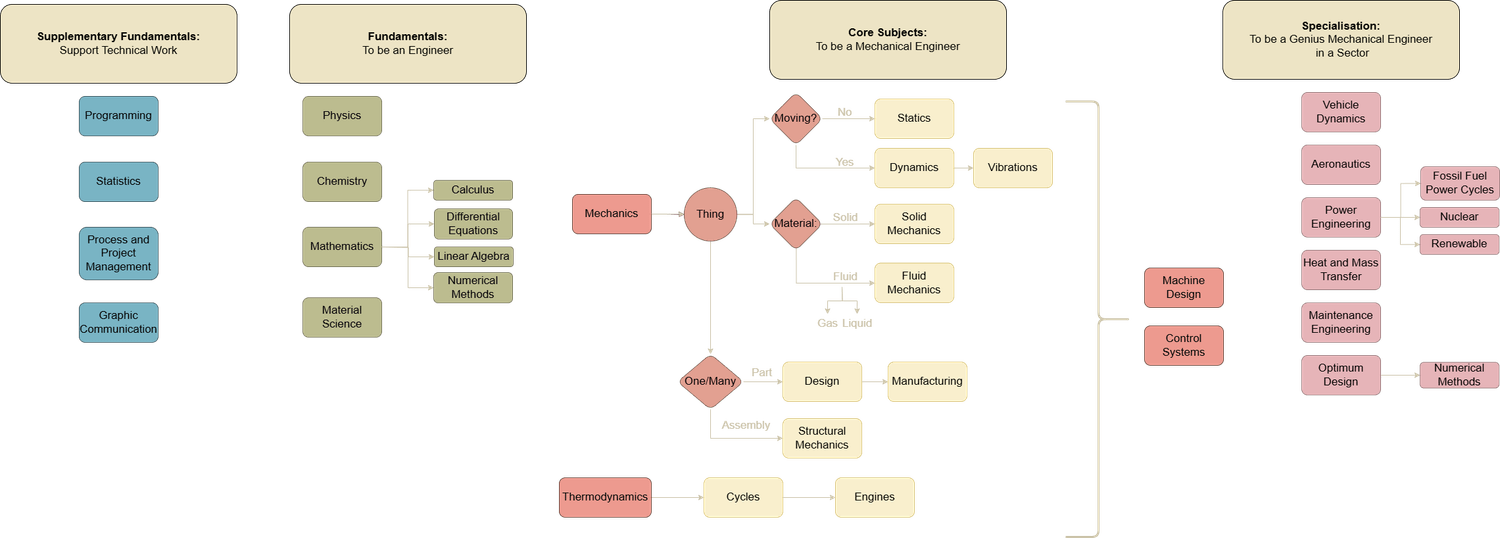
See? It’s just this.
When the mechanical engineering student reaches final year, having been introduced to each of the subjects, they may have a clear direction in which they want to go. Or , they might enjoy the subject matter of one subject more than another. From this, is born specialisations. The principles of Mechanics and Thermodynamics play a role in every specialisation, to some degree.
The supplementary fundamentals become tools that make analysis, design, problem solving possible through their application: you use statistics for data analysis to aid in prediction, you use programming as your language to automate, you use graphic design to communicate, you use process and project management to guide your tasklist.
The fundamentals become the analysis backbone: rules to play with numbers and physical properties like time, matter, space and energy.
So, now you know.
Cheers.

Hannalie Vergotine
A work of intrinsic worth